Bob Dutko is a smart guy, but he's got a tough task as a radio talk show host. He needs to be prepared for anything. Anybody can call him on a Friday and challenge him on anything. Obviously since a caller knows what he intends to talk about he can be fully prepared with facts and figures that Bob isn't intimately familiar with.
I think Bob makes up for this by talking over his callers and doing a little bit of filibustering, but I can hardly blame him because he is at a disadvantage. Even still he does usually give me a chance to express my question or challenge, so I do give him credit for that.
He's made many bold claims. One is that there are no transitional fossils. I was thinking about this claim, and how it is Bob can make it when obviously he doesn't know all the specimens available. It occurred to me that he can say it because nothing is a transitional fossil in Bob's world. No matter what you present to him he'll just say it's one of God's unique creatures now extinct, or it's a deformed existing animal. It will never be that the fossil descended from a different species and has since evolved into another species.
So I thought I'd give him a call, describe what I would consider a transitional fossil, concede that I know he won't see it the same way and will call it one of God's unique creatures, at which point I'd ask him to describe what would qualify as a transitional fossil in his mind. He can't describe one, because for him there is no such thing. Listen here.
I knew he wouldn't answer my question, and he didn't. Unfortunately I didn't get the question out early enough to press him on it because he jumped in and talked for long stretches, but it was still a pretty good call as far as I'm concerned.
He asserts that everything we see in the fossil record ought to appear transitional. I corrected him on this point and said in fact most of what we see should appear from our perspective as extinct, since most of the nodes on the evolutionary tree are dead ends. This is very difficult to explain for a young earth creationist. He just denied my claim, but my claim is certainly true. For proof see here and here.
Friday, March 27, 2009

Thursday, March 26, 2009
Reasonable Usage of Scholars
Is it reasonable to accept FACTS asserted by scholars when you are unaware of any dispute on the matter and you don't personally have expertise in the area?
Jason recently wrote a post justifying why he ignores questions I pose to him in our debates. Among other reasons he points to the fact that I didn't respond to certain arguments he posed just prior to the time I moved three and a half years ago. Jason says that is reasonable, but what is unreasonable is that when I involved myself in discussions again I didn't get back to those same arguments. I told him that I didn't have copies of them and they were no longer available on line and that I would be happy to respond if I could access them. He made statements which made me think he did have copies, so I asked him to send them. He didn't respond to my request. Yet he is still criticizing me for not responding to these arguments.
It seems to me that these are just the games Jason plays to extract himself from tough situations. Fine. Doesn't matter. I'm going to continue to ask questions, as I've asked follow up questions in the comments section here, and Jason can just continue to believe he's justified in ignoring them.
My arguments about the reliability of Josephus have depended on a claim I made regarding scholars. I say that it is reasonable to accept historical facts if they are claimed by experts in the field. So for instance, Robert Eisenmann claims that statements from Josephus can be cross checked with other ancient sources. I accept the claim. I'm unaware of any dispute on the matter. He says that Josephus gives good information about the political background situation of the events he describes. I don't have the citations, but I accept the claim based upon Eisenmann's assertion. I'm unaware of any dispute on the matter.
I formulated arguments for the reliability of Josephus based upon the facts asserted by Eisenmann.
Jason has been arguing that I'm not justified in adhering to such facts. He demands that I produce the sources being cross checked. He asks if the language on the relevant artifacts is being interpreted correctly.
I say I don't need to do that. To illustrate this point I said that if Bart Ehrman asserts that an interpolation exists in a manuscript I'm justified in believing there is an interpolation where Ehrman claims without handling or seeing the manuscript myself. I'm not saying I can likewise just affirm all of Ehrman's opinions on controversial issues. I'm saying facts of the case can reasonably be affirmed on the basis of a scholarly opinion.
I think that's a pretty reasonable view. Initially Jason disagreed. But since then he continues to act like he disagrees, but he doesn't make it clear what he's arguing. He's talking about how Eisenmann has a vested interest in making Josephus appear reliable. He says that I haven't proven that Eisenmann's "view of Josephus" is undisputed. Also Eisenmann has engaged in some annoying behavior and holds some controversial views on OTHER topics. What does any of this have to do with my claim that it is reasonable to affirm a FACT if an expert in the field asserts it and you don't have expertise in the area?
What do you mean, Jason, when you say Eisenmann's "view of Josephus"? Do you mean his overall opinion of the reliability of Josephus or do you mean his claims regarding facts about Josephus?
I'll be clear, even though Jason isn't being clear about what he's arguing. I haven't claimed that Eisenmann's views regarding the reliability of Josephus are undisputed. This is not about Eisenmann's opinions on the reliability of Josephus. I've put certain facts on the table, supported by Eisenmann, and I formulated arguments for the reliability of Josephus on this basis. Look high and low throughout my posts and you will not see me argue that Josephus is reliable because Eisenmann said so. I did offer a summary from Eisenmann that basically affirmed the conclusions I drew from the facts, and that summary provided a couple of more facts, including some of his weaknesses. But the actual basis for my claims has been clear. It is not Eisenmann's opinion. It is arguments I formulated on the basis of facts such as these:
1-Josephus provides an autobiography
2-His claims can be cross checked with other ancient sources
3-His reports are quite detailed. The nature of the details suggests an impressive mind
4-Some of his reports are likely based upon direct interrogations
5-He describes the political background situation
6-He admits his biases in a section that appears self-critical
7-His reporting of minutiae can be described as meticulous
8-His reporting appears encyclopaedic in its details
Of course being detailed doesn't make a person reliable. Appearing encyclopaedic doesn't make a person accurate. But I formulated arguments based upon the above facts that make it reasonable to think Josephus is more reliable than the NT. This doesn't mean he never lies, never contradicts himself, never makes mistakes. Jason quotes scholars asserting those points. But he hasn't quoted anyone denying the facts I've listed.
If he does, fine. I'm interested. But I'm reasonable to accept facts asserted by scholars that I'm not aware are contradicted by anyone.
So there's my question for Jason. Is it reasonable to accept FACTS asserted by scholars when you are unaware of any dispute on the matter? Nobody is claiming that there is no variance amongst scholars about the general reliability of Josephus. That would be absurd (which is probably why you're characterizing my view this way). I'm simply affirming the position I said way back at the beginning.
In pressing Jason on this point I had predicted that he might quote my questions, but he would not reply on substance. That prediction has proven to be true. Does Jason deny that an opinion of a scholar is a reasonable basis to affirm a non-controversial fact? Jason won't answer this question after all this time. He'll say he won't answer because I haven't responded to an argument that is no longer available to me from 3.5 years ago (among other reasons). Does he really think anybody believes that?
So watch for a reply from Jason. It might be quite lengthy. But if you read it, see if it actual answers this question:
Is it reasonable to accept FACTS asserted by scholars when you are unaware of any dispute on the matter and you don't personally have expertise in the area?
Jason recently wrote a post justifying why he ignores questions I pose to him in our debates. Among other reasons he points to the fact that I didn't respond to certain arguments he posed just prior to the time I moved three and a half years ago. Jason says that is reasonable, but what is unreasonable is that when I involved myself in discussions again I didn't get back to those same arguments. I told him that I didn't have copies of them and they were no longer available on line and that I would be happy to respond if I could access them. He made statements which made me think he did have copies, so I asked him to send them. He didn't respond to my request. Yet he is still criticizing me for not responding to these arguments.
It seems to me that these are just the games Jason plays to extract himself from tough situations. Fine. Doesn't matter. I'm going to continue to ask questions, as I've asked follow up questions in the comments section here, and Jason can just continue to believe he's justified in ignoring them.
My arguments about the reliability of Josephus have depended on a claim I made regarding scholars. I say that it is reasonable to accept historical facts if they are claimed by experts in the field. So for instance, Robert Eisenmann claims that statements from Josephus can be cross checked with other ancient sources. I accept the claim. I'm unaware of any dispute on the matter. He says that Josephus gives good information about the political background situation of the events he describes. I don't have the citations, but I accept the claim based upon Eisenmann's assertion. I'm unaware of any dispute on the matter.
I formulated arguments for the reliability of Josephus based upon the facts asserted by Eisenmann.
Jason has been arguing that I'm not justified in adhering to such facts. He demands that I produce the sources being cross checked. He asks if the language on the relevant artifacts is being interpreted correctly.
I say I don't need to do that. To illustrate this point I said that if Bart Ehrman asserts that an interpolation exists in a manuscript I'm justified in believing there is an interpolation where Ehrman claims without handling or seeing the manuscript myself. I'm not saying I can likewise just affirm all of Ehrman's opinions on controversial issues. I'm saying facts of the case can reasonably be affirmed on the basis of a scholarly opinion.
I think that's a pretty reasonable view. Initially Jason disagreed. But since then he continues to act like he disagrees, but he doesn't make it clear what he's arguing. He's talking about how Eisenmann has a vested interest in making Josephus appear reliable. He says that I haven't proven that Eisenmann's "view of Josephus" is undisputed. Also Eisenmann has engaged in some annoying behavior and holds some controversial views on OTHER topics. What does any of this have to do with my claim that it is reasonable to affirm a FACT if an expert in the field asserts it and you don't have expertise in the area?
What do you mean, Jason, when you say Eisenmann's "view of Josephus"? Do you mean his overall opinion of the reliability of Josephus or do you mean his claims regarding facts about Josephus?
I'll be clear, even though Jason isn't being clear about what he's arguing. I haven't claimed that Eisenmann's views regarding the reliability of Josephus are undisputed. This is not about Eisenmann's opinions on the reliability of Josephus. I've put certain facts on the table, supported by Eisenmann, and I formulated arguments for the reliability of Josephus on this basis. Look high and low throughout my posts and you will not see me argue that Josephus is reliable because Eisenmann said so. I did offer a summary from Eisenmann that basically affirmed the conclusions I drew from the facts, and that summary provided a couple of more facts, including some of his weaknesses. But the actual basis for my claims has been clear. It is not Eisenmann's opinion. It is arguments I formulated on the basis of facts such as these:
1-Josephus provides an autobiography
2-His claims can be cross checked with other ancient sources
3-His reports are quite detailed. The nature of the details suggests an impressive mind
4-Some of his reports are likely based upon direct interrogations
5-He describes the political background situation
6-He admits his biases in a section that appears self-critical
7-His reporting of minutiae can be described as meticulous
8-His reporting appears encyclopaedic in its details
Of course being detailed doesn't make a person reliable. Appearing encyclopaedic doesn't make a person accurate. But I formulated arguments based upon the above facts that make it reasonable to think Josephus is more reliable than the NT. This doesn't mean he never lies, never contradicts himself, never makes mistakes. Jason quotes scholars asserting those points. But he hasn't quoted anyone denying the facts I've listed.
If he does, fine. I'm interested. But I'm reasonable to accept facts asserted by scholars that I'm not aware are contradicted by anyone.
So there's my question for Jason. Is it reasonable to accept FACTS asserted by scholars when you are unaware of any dispute on the matter? Nobody is claiming that there is no variance amongst scholars about the general reliability of Josephus. That would be absurd (which is probably why you're characterizing my view this way). I'm simply affirming the position I said way back at the beginning.
In pressing Jason on this point I had predicted that he might quote my questions, but he would not reply on substance. That prediction has proven to be true. Does Jason deny that an opinion of a scholar is a reasonable basis to affirm a non-controversial fact? Jason won't answer this question after all this time. He'll say he won't answer because I haven't responded to an argument that is no longer available to me from 3.5 years ago (among other reasons). Does he really think anybody believes that?
So watch for a reply from Jason. It might be quite lengthy. But if you read it, see if it actual answers this question:
Is it reasonable to accept FACTS asserted by scholars when you are unaware of any dispute on the matter and you don't personally have expertise in the area?
Sunday, March 22, 2009
I, Paul
You gotta be careful arguing with Jason Engwer. If you say something and you don't qualify it up down and sideways he'll jump all over you as if he's found a very important mistake. For instance recently I had said with regards to the arguments of some of the Dutch radical critics "Why doesn't someone actually try and deal with the arguments?" This is pay dirt for Jason. Worthy of a whole new post. After all a few internet apologists have said a few things. There was a webcast where some issues tangential to this were dealt with. Yeah, yeah, ya got me. To say nobody in the history of internet apologism has ever said one thing in response to the Dutch radicals, I guess I'm wrong. Congratulations.
Way back when I had said "I Paul" references would make one suspicious because these type of references are common in pseudonymous works and would be a "dead give away to forgery." Whoo boy. That was too far. Jason has pay dirt. Dead give away? "So if these two words are strung together in any sense without regard to context I should assume forgery? See how ridiculous Jon is?"
Well, OK. I'll offer some more of those qualifications that Jason apparently can't see.
But let's start with my basic contention. What of "I, Paul" references. Is it true that we find these in pseudonymous works? Absolutely. They're all over the place.
Gospel of Peter 14:3
But I, Simon Peter, and Andrew my brother, took our fishing nets and went to the sea. With us was Levi, the son of Alphaeus, whom the Lord...
Apocalypse of Peter
And I, Peter, answered and said unto him: Interpret unto me concerning the fig-tree,
Apocryphon of John 1:19
When I, John, heard these things I turned away from the temple to a desert place.
Book of Thomas the Contendor (1:2)
The secret words that the savior spoke to Judas Thomas which I, even I, Mathaias, wrote down, while I was walking, listening to them speak with one another.
Revelation 1:9
I John, your brother and partaker with you in tribulation and kingdom and patience which are in Jesus, was in the isle that is called Patmos, for the word of God and the testimony of Jesus.
Testimony of the 12 Patriarchs III:2:
I Levi was conceived in Haran and born there,
Infancy Gospel of Thomas 1:1
I, Thomas the Israelite, am reporting to you, all my brothers from the nations, to reveal the childhood and the greatness of our Lord Jesus Christ, what he did in my country after he was born.
Apocalypse of Zephaniah B:7
Truly, I, Zephaniah, saw these things in my vision.
1 Enoch 105:13
Then I, Enoch, answered and said, The Lord will effect a new thing upon the earth.
Testament of Solomon
5. Now when I Solomon heard this, I entered the Temple of God, and prayed with all my soul,
Tobit 1:3
I Tobit have walked all the days of my life in the ways of truth and justice, and I did many almsdeeds to my brethren, and my nation, who came with me to Nineve, into the land of the Assyrians.
Daniel 7:15
I Daniel was grieved in my spirit in the midst of my body, and the visions of my head troubled me.
Looks pretty clear that I, (name) is a forgers technique. Rather than deal with the fact that this is all over pseudonymous writings, Jason will focus on how I had said it's a "dead give away" (even though I had also said it is "suspicious" which implies it's not a certainty). Do the facts matter to Jason, or is my potential overstatement the only thing worth talking about?
What we're seeing in these cases is the authors protesting authorial identity. It's not about introducing people to an author that the readers don't otherwise know. This is about an author identifying himself as a person that is highly regarded and has status. It's pretty obvious why a forger would use such a technique. It might compel readers to treat the text as something that is very important.
And it's not just Dutch radical type people that recognize this as a forgers technique. As Jason pointed out, I cited Bart Ehrman in support of this claim. Ehrman takes all the standard (what I would call conservative) lines on Pauline authorship. He accepts the 7 supposedly authentic letters from Paul. Even still he understands that this is a forgers technique.
So my basic contention (which I qualified for Jason's benefit) is that this is indicative of forgery. It may not be all the time, but it's certainly something that should raise suspicion. Given that we see it frequently in pseudonymous works, and I have yet to see it in works regarded as genuine, we should obviously look at such texts with suspicion, right? Does Jason deny this? Isn't it obvious?
But now Jason says that some translators claim Josephus uses the phrase. Jason doesn't tell us exactly where to find this passage except to say it at the opening of War. Probably this is the passage:
I have proposed to myself, for the sake of such as live under the government of the Romans, to translate those books into the Greek tongue, which I formerly composed in the language of our country, and sent to the Upper Barbarians; (2) Joseph, the son of Matthias, by birth a Hebrew, a priest also, and one who at first fought against the Romans myself, and was forced to be present at what was done afterwards, [am the author of this work].
Presumably just prior to "Joseph" it could be translated "I, Joseph". That could be and doesn't look all that suspicious. What's the difference? In this case the author appears to be identifying himself for those that don't know him. This is who I am, where I'm from, what I did, who my father is, etc. The word "I" could land next to the name "Joseph" in such a context without necessarily suggesting anything about pseudonymity.
In the case of the spurious texts above it's not about letting people know who a person is. It's basically just name dropping. In that context it would appear much as it appears in spurious documents. Which do the Pauline epistles look like? They look just like the spurious texts listed above.
Way back when I had said "I Paul" references would make one suspicious because these type of references are common in pseudonymous works and would be a "dead give away to forgery." Whoo boy. That was too far. Jason has pay dirt. Dead give away? "So if these two words are strung together in any sense without regard to context I should assume forgery? See how ridiculous Jon is?"
Well, OK. I'll offer some more of those qualifications that Jason apparently can't see.
But let's start with my basic contention. What of "I, Paul" references. Is it true that we find these in pseudonymous works? Absolutely. They're all over the place.
Gospel of Peter 14:3
But I, Simon Peter, and Andrew my brother, took our fishing nets and went to the sea. With us was Levi, the son of Alphaeus, whom the Lord...
Apocalypse of Peter
And I, Peter, answered and said unto him: Interpret unto me concerning the fig-tree,
Apocryphon of John 1:19
When I, John, heard these things I turned away from the temple to a desert place.
Book of Thomas the Contendor (1:2)
The secret words that the savior spoke to Judas Thomas which I, even I, Mathaias, wrote down, while I was walking, listening to them speak with one another.
Revelation 1:9
I John, your brother and partaker with you in tribulation and kingdom and patience which are in Jesus, was in the isle that is called Patmos, for the word of God and the testimony of Jesus.
Testimony of the 12 Patriarchs III:2:
I Levi was conceived in Haran and born there,
Infancy Gospel of Thomas 1:1
I, Thomas the Israelite, am reporting to you, all my brothers from the nations, to reveal the childhood and the greatness of our Lord Jesus Christ, what he did in my country after he was born.
Apocalypse of Zephaniah B:7
Truly, I, Zephaniah, saw these things in my vision.
1 Enoch 105:13
Then I, Enoch, answered and said, The Lord will effect a new thing upon the earth.
Testament of Solomon
5. Now when I Solomon heard this, I entered the Temple of God, and prayed with all my soul,
Tobit 1:3
I Tobit have walked all the days of my life in the ways of truth and justice, and I did many almsdeeds to my brethren, and my nation, who came with me to Nineve, into the land of the Assyrians.
Daniel 7:15
I Daniel was grieved in my spirit in the midst of my body, and the visions of my head troubled me.
Looks pretty clear that I, (name) is a forgers technique. Rather than deal with the fact that this is all over pseudonymous writings, Jason will focus on how I had said it's a "dead give away" (even though I had also said it is "suspicious" which implies it's not a certainty). Do the facts matter to Jason, or is my potential overstatement the only thing worth talking about?
What we're seeing in these cases is the authors protesting authorial identity. It's not about introducing people to an author that the readers don't otherwise know. This is about an author identifying himself as a person that is highly regarded and has status. It's pretty obvious why a forger would use such a technique. It might compel readers to treat the text as something that is very important.
And it's not just Dutch radical type people that recognize this as a forgers technique. As Jason pointed out, I cited Bart Ehrman in support of this claim. Ehrman takes all the standard (what I would call conservative) lines on Pauline authorship. He accepts the 7 supposedly authentic letters from Paul. Even still he understands that this is a forgers technique.
So my basic contention (which I qualified for Jason's benefit) is that this is indicative of forgery. It may not be all the time, but it's certainly something that should raise suspicion. Given that we see it frequently in pseudonymous works, and I have yet to see it in works regarded as genuine, we should obviously look at such texts with suspicion, right? Does Jason deny this? Isn't it obvious?
But now Jason says that some translators claim Josephus uses the phrase. Jason doesn't tell us exactly where to find this passage except to say it at the opening of War. Probably this is the passage:
I have proposed to myself, for the sake of such as live under the government of the Romans, to translate those books into the Greek tongue, which I formerly composed in the language of our country, and sent to the Upper Barbarians; (2) Joseph, the son of Matthias, by birth a Hebrew, a priest also, and one who at first fought against the Romans myself, and was forced to be present at what was done afterwards, [am the author of this work].
Presumably just prior to "Joseph" it could be translated "I, Joseph". That could be and doesn't look all that suspicious. What's the difference? In this case the author appears to be identifying himself for those that don't know him. This is who I am, where I'm from, what I did, who my father is, etc. The word "I" could land next to the name "Joseph" in such a context without necessarily suggesting anything about pseudonymity.
In the case of the spurious texts above it's not about letting people know who a person is. It's basically just name dropping. In that context it would appear much as it appears in spurious documents. Which do the Pauline epistles look like? They look just like the spurious texts listed above.
Questions for Jason
The extended and wide ranging discussion with Jason Engwer continues. It's all very disorganized. I'm banned at Triablogue, so I can't respond there, which would allow for a continuous thread. So everything is everywhere.
But it's just as well, because these days you never know if they're going to delete everything you've posted. For instance John Loftus has offered many thoughtful posts there. They're all now gone as punishment I suppose. Rebuttals to his arguments remain, but his counters aren't viewable. Perhaps they are attempting to protect viewers from potential faith shaking information. To me though the attempt to shield viewers from certain statements is more faith shaking than anything. But to each his own.
Jason is continuing his pattern of lots of verbiage, little substance. He raises a topic and as I rebut he just hops to a new argument and ignores my rebuttal. I'll illustrate some of the things he's dodged with a series of questions.
1-You say that skeptics are inconsistent in that the arguments they use to discredit the NT would also discredit Tacitus. Tell us which skeptics you have in mind and what their arguments are regarding Tacitus.
2-You say that I'm inconsistent because Josephus used an assistant, yet I've "ignored" the use of an assistant for the NT. What does this argument mean?
3-You keep repeating the charge that some scholars regard Josephus as a liar. Why do you keep repeating this when I've already said I'd be open to that and this doesn't mean the other information he offers shouldn't be trusted?
4-You quote the opinions of conservative evangelicals to the effect that you are right and we skeptics are wrong. I don't think that's very compelling. You responded by asking if we should treat Richard Carrier the same way. I said we should. Do you now concede that quoting the opinions of friendly sources is not very compelling and certainly does not constitute an argument?
5-You claim that I posit an interpolation at Mt 17. Do you admit that this is not true?
6-You claim that a report can't be an eyewitness report if we don't have the name. Do you now admit that this is false?
7-Is it unreasonable to accept the scholarly position when you are unaware of any dispute on the matter even though you may not have first hand knowledge? Like germ theory for instance? You've responded by saying Eisenmann is weird, read his table of contents at a lecture, has minority opinions on other issues. How is any of that relevant to my point?
8-I claim an anachronism in Romans. You claim a potential anachronism from Josephus and suggest that since I believe Romans contains an anachronism and reject Pauline authorship on this basis (though in fact there are additional reasons), I should likewise reject Josephus. Isn't it a fact that not every anachronism is proof of forgery? The anachronism you claim from Josephus doesn't necessarily imply forgery, but the one in Romans obviously does.
9-Please elaborate on the verisimilitude argument of yours. I think it makes no sense at all, just like the amanuensis argument referenced above. Show me that I'm wrong or admit you aren't making any sense.
It seems I'm raising points, and rather than giving answers you just move on to a new argument. Or you offer a defense of what is not in dispute as I document in the comment section here. Now it's "I, Josephus." When I've dealt with that it will be on to the next point. We'll write over 95 pages again and just go from one thing to the next. You ought to deal with the issues on the table before moving on to new topics. Either answer the questions or concede your errors.
But it's just as well, because these days you never know if they're going to delete everything you've posted. For instance John Loftus has offered many thoughtful posts there. They're all now gone as punishment I suppose. Rebuttals to his arguments remain, but his counters aren't viewable. Perhaps they are attempting to protect viewers from potential faith shaking information. To me though the attempt to shield viewers from certain statements is more faith shaking than anything. But to each his own.
Jason is continuing his pattern of lots of verbiage, little substance. He raises a topic and as I rebut he just hops to a new argument and ignores my rebuttal. I'll illustrate some of the things he's dodged with a series of questions.
1-You say that skeptics are inconsistent in that the arguments they use to discredit the NT would also discredit Tacitus. Tell us which skeptics you have in mind and what their arguments are regarding Tacitus.
2-You say that I'm inconsistent because Josephus used an assistant, yet I've "ignored" the use of an assistant for the NT. What does this argument mean?
3-You keep repeating the charge that some scholars regard Josephus as a liar. Why do you keep repeating this when I've already said I'd be open to that and this doesn't mean the other information he offers shouldn't be trusted?
4-You quote the opinions of conservative evangelicals to the effect that you are right and we skeptics are wrong. I don't think that's very compelling. You responded by asking if we should treat Richard Carrier the same way. I said we should. Do you now concede that quoting the opinions of friendly sources is not very compelling and certainly does not constitute an argument?
5-You claim that I posit an interpolation at Mt 17. Do you admit that this is not true?
6-You claim that a report can't be an eyewitness report if we don't have the name. Do you now admit that this is false?
7-Is it unreasonable to accept the scholarly position when you are unaware of any dispute on the matter even though you may not have first hand knowledge? Like germ theory for instance? You've responded by saying Eisenmann is weird, read his table of contents at a lecture, has minority opinions on other issues. How is any of that relevant to my point?
8-I claim an anachronism in Romans. You claim a potential anachronism from Josephus and suggest that since I believe Romans contains an anachronism and reject Pauline authorship on this basis (though in fact there are additional reasons), I should likewise reject Josephus. Isn't it a fact that not every anachronism is proof of forgery? The anachronism you claim from Josephus doesn't necessarily imply forgery, but the one in Romans obviously does.
9-Please elaborate on the verisimilitude argument of yours. I think it makes no sense at all, just like the amanuensis argument referenced above. Show me that I'm wrong or admit you aren't making any sense.
It seems I'm raising points, and rather than giving answers you just move on to a new argument. Or you offer a defense of what is not in dispute as I document in the comment section here. Now it's "I, Josephus." When I've dealt with that it will be on to the next point. We'll write over 95 pages again and just go from one thing to the next. You ought to deal with the issues on the table before moving on to new topics. Either answer the questions or concede your errors.
Our Idiotic Government and AIG's Critics
AIG appears to be a pretty badly run company. They insured mortgages and badly miscalculated the risk of default. When the risk was realized they found themselves on the brink of collapse.
Our government has stepped in with our tax dollars as well as billions borrowed in our children's names and given AIG a few multi-billion dollar blank checks. What is this poorly run company doing with the money? Among other things they are passing out multi-million dollar bonuses, some of which are to people that no longer work for the company.
Everyone is ticked. But where are they directing their anger? AIG. Not so much the government. As Stossel would say, give me a break.
What do you expect wasteful companies to do when you don't allow the market to punish them for their wasteful practices? They'll keep doing what they've been doing. If the government offered the company I work for billions in bail out money and the company offered me a million a month to keep doing what I'm doing, guess what I'd do? I'd take the money.
If you're looking for a place to invest billions of dollars and you find a poorly managed company that has a history of making decisions that lead to bankruptcy and you give them your billions and they continue to make poor decisions, who is to blame? This is like blaming a heroine addict for getting high after you've provided him with all the drugs he wants.
What your so-called conservatives might say at this point is "We need to pay these bonuses because we need to retain the talent required to get us out of this mess. You want crappy executives running the company? That will make things worse."
My response, as a person that sees the value of truly free markets, is that you don't know that. You don't know that you are really getting millions of dollars in value from these executives. That's the whole point of a free market. If these executives bring value, then the market will reward them, and if not the market will punish them.
Now we've decided we will not let the market punish them. So Obama and the rest of the central planners will step in and decide what their wages should be. But he cannot do this successfully. He cannot know if these high salaries really bring this kind of value. A market can. But a market has to be allowed to punish failure. And in America we don't do that. At least we don't do it for companies that are large and have people lobbying Washington on their behalf.
Our government has stepped in with our tax dollars as well as billions borrowed in our children's names and given AIG a few multi-billion dollar blank checks. What is this poorly run company doing with the money? Among other things they are passing out multi-million dollar bonuses, some of which are to people that no longer work for the company.
Everyone is ticked. But where are they directing their anger? AIG. Not so much the government. As Stossel would say, give me a break.
What do you expect wasteful companies to do when you don't allow the market to punish them for their wasteful practices? They'll keep doing what they've been doing. If the government offered the company I work for billions in bail out money and the company offered me a million a month to keep doing what I'm doing, guess what I'd do? I'd take the money.
If you're looking for a place to invest billions of dollars and you find a poorly managed company that has a history of making decisions that lead to bankruptcy and you give them your billions and they continue to make poor decisions, who is to blame? This is like blaming a heroine addict for getting high after you've provided him with all the drugs he wants.
What your so-called conservatives might say at this point is "We need to pay these bonuses because we need to retain the talent required to get us out of this mess. You want crappy executives running the company? That will make things worse."
My response, as a person that sees the value of truly free markets, is that you don't know that. You don't know that you are really getting millions of dollars in value from these executives. That's the whole point of a free market. If these executives bring value, then the market will reward them, and if not the market will punish them.
Now we've decided we will not let the market punish them. So Obama and the rest of the central planners will step in and decide what their wages should be. But he cannot do this successfully. He cannot know if these high salaries really bring this kind of value. A market can. But a market has to be allowed to punish failure. And in America we don't do that. At least we don't do it for companies that are large and have people lobbying Washington on their behalf.
Saturday, March 21, 2009
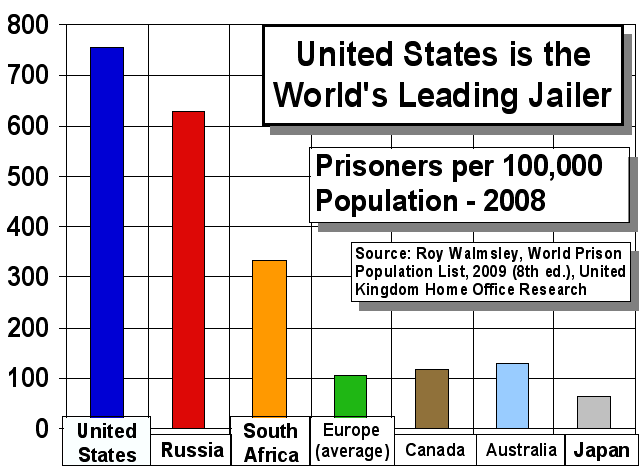
We Imprison a Lot of People
AIG Busted had a post on a Montana fossil hunter facing 10 years in prison for digging in remote areas people couldn't care less about. I guess he didn't get the proper paper work from our nanny state government officials. This reminds me of a couple of graphs I recently saw. I understand that China, with 4x the population of the United States, has only 500,000 people in prison.

Thursday, March 19, 2009
Subscribe to:
Posts (Atom)