Saturday, August 13, 2011

Why Is The Propaganda Model Controversial

How should the media function in our society and how does it function? There are two views typically expressed within the media. One is that the media is adversarial and iconoclastic and that this is how it should be. It's fulfilling it's traditional Jeffersonian role. That is it serves as a check on power. It exposes corruption and evil. It's true that this can sometimes weaken power and weaken American interests in the short term, but it's necessary to have that exposure in an open democratic society.

The other view is that yes, the media is adversarial and iconoclastic, but this is a bad thing. Or at least they go too far. They shouldn't bash America, criticize our behavior, expose our weaknesses, etc because America is really the beacon of light in the world. This kind of criticism undermines our prestige and diminishes our ability to act for the good of the world.

The former view is regarded as the left/liberal view within the media and the latter view is more the right/conservative view. So take an issue like Vietnam. Sure the media was critical. But that's what we need, says the left. Questioning power and criticizing America was what we should have been doing. No, says the right. They were very critical. But this harmed American interests. Perhaps we would have succeeded in Vietnam if the press weren't so adversarial.

These two views start from the same assumption. The media in fact is adversarial and contrary to power. Both sides recognize that they act this way for what they perceive to be the good of democracy.

What's not discussed is the fact that there is a third view. A view that doesn't share the assumption. This view is that in fact the media are not adversarial. In fact they are subservient to power. And in fact they function to serve the interests of power and wealth at the expense of democracy. This view is known as the Propaganda Model.

If you really want to know which view is right you have to look at the actual media product. Chomsky, Herman, and others have done a lot of that. It's a lot of work and it's subject to an important criticism. When you are looking at these kinds of questions in the social sciences anyone can charge you with picking examples that support your point while excluding others that undermine your point. So what Chomsky and Herman do is they do their best to allow their critics to choose the examples. Supposedly Vietnam and Watergate show that the media is adversarial, so Chomsky and Herman focus on these. In my view their case is convincing. Even these examples adhere very well to the propaganda model and do not at all conform to the typically expressed view that the media is adversarial.

But I don't want to focus on the evidence here. I want to just articulate a view expressed by Chomsky in a lecture he offered years ago called Thought Control in a Democratic Society (which also makes the same points I make above). When I explain these views, some critics react as if this is very bizarre, like it's a conspiracy theory. It obviously sounds very foreign to them. Why is that? I would think that people would regard it as plausible, or even likely just based on background knowledge. Consider the following three points.

Number one, political elites openly advocate on behalf of a media that functions precisely as the PM describes it. Some good examples of this advocacy can be viewed at the chapter 1 notes on Understanding Power starting at 38. Let me offer a couple of excerpts from Edward Bernays, the founder of Public Relations (and person responsible for pioneering the idea of invoking the Communist menace as a means of rallying public opinion behind the violent overthrow of unfavored governments).
The conscious and intelligent manipulation of the organized habits and opinions of the masses is an important element in democratic society. Those who manipulate this unseen mechanism of society constitute an invisible government which is the true ruling power of our country.

More from Bernays:
[R]egard for men in the mass rests upon no democratic dogmatisms about men being the best judges of their own interests.

[The spread of schooling] did not release the masses from ignorance and superstition but altered the nature of both and compelled the development of a whole new technique of control, largely through propaganda . . . [which] attains eminence as the one means of mass mobilization which is cheaper than violence, bribery or other possible control techniques . . . [and] is no more moral or immoral than a pump handle. . . . [It is] certain that propaganda will in time be viewed with fewer misgivings.

So that's the first point. Political elites openly advocate that the media function as the Propaganda Model suggests. The second point is that this is that this is precisely what you would expect based merely on recognition of who the media is and who they serve.

So what is the media? That is, what is the major, agenda setting media, like the NY Times or the network news? These are major corporations. Some are subsidiaries of even larger mega corporations. And who are their customers? It's not the viewers or readers. That's not the customer. That's the product. That's what's being sold. The customers are the advertisers. Who are they? Once again major corporations. This is a tiny, extremely wealthy sector of our society. So without even looking at the media product, what kind of a picture of the world would we expect to emerge from an institution that is itself major corporations and has major corporations as a customer base? Would we expect a cantankerous, obstinate, Jeffersonian institution seeking to undermine power and serve democratic interests? No. We'd expect a product that serves the interests of the tiny number of wealthy owners and advertisers. That expectation is based on basic free market assumptions just from looking at incentives.

Thirdly, and perhaps more tentatively, we might ask what the public thinks. Does the public view the media as adversarial or subservient to power? Some polls show that large majorities in fact think the media is too too subservient to power.

You wouldn't conclude that the propaganda model is true based on these three points. But what you would expect is that it would at least be part of the discussion. And yet it's not. The views expressed range from the media is adversarial and we need it to be such to the view that it's too adversarial. This in fact is even more reason to conclude that the PM is correct even before looking to the evidence. Why is that?

Because the PM actually predicts that the model would not be part of the mainstream discussion. The reason is because it's dysfunctional. On the PM the role of the media is to undermine democracy and serve power. To expose that would be to undermine the ability of the media to fulfill it's role. The system filters out dysfunctional elements. So if the model is true it will be expelled. If it's false you wouldn't expect it to be discussed. So it's not going to be discussed.

The mark of a good model is that it can predict behavior that would otherwise be unexpected on an alternative model. That's what the PM does. And yet many people that I know react to the PM like it's some sort of bizarre conspiracy theory. Why?

Is it the power of the echo chamber? Since you never hear discussion of the PM in mainstream sources, but only hear the other views, the PM sounds implausible. I wonder if people don't trust themselves to think things through, so they just repeat what they always hear.

Or maybe it's just the fact that I know a lot of right wingers, and this is too threatening to their worldview. Or maybe my contacts in the debating world are adversarial people and they react negatively instinctively. Maybe if I broadened my circle of contacts I'd see other reactions. Perhaps I'll experiment with that.

Thursday, August 11, 2011

Serious About Deficit Reduction? The Solution Is Single Payer

The editorial board at St. Louis Today states that everyone that has studied the deficit problem knows that in fact it is a health care problem. Letting the tax cuts expire would do it, but why even bother taking more from the rich? Private insurance bureaucracy and paperwork consumes an astonishing one third of our off the scale expensive health care system. The $400 billion savings associated with addressing that is alone enough to provide high quality care for every American. Canada and Britain, which have lower GDP and still spend a much lower % of their GDP on health care, still provide care for everyone that is at least as good as what we have here.

The editorial says we're getting a single payer plan one way or the other. There is no feasible alternative. Should we wait a few more years and sustain crappy care while exploding our total debt, or should we just fix it now, have better care, and eliminate our deficit. Maybe start paying down the debt. The answer should be obvious.

Wednesday, August 10, 2011

Our Ongoing Terrorist War Against Cuba

Imagine living in a sleepy town and being awoken in the middle of the night by armed bandits spraying machine gun fire all around in an effort to kill as many defenseless people as possible. Or imagine being a sugar farmer that must deal with foreign aircraft that fly in and spray your crops with biological agents intended to destroy what you've created. Imagine living with the prospect of a neighbor 90 miles from you that routinely introduces things like Dengue Fever or Swine Flu in an effort to destroy both you, your children, and your livestock.

That's all pretty horrifying. There are a lot of horrors in this world. But this one in my view deserves special attention. Why? Because it is a horror that we are responsible for. This is a horror that our government is involved in and that means it is a horror that we can change.

We don't because we've never heard of it. And of course there's a reason for that. Still, we need to do better.

How many people know about what was the most severe terrorist incident that involved a commercial airliner in our hemisphere prior to 9-11? Very few. That's bad enough. But how many know that the two people responsible for planning this attack have been residing comfortably in Miami? Orlando Bosch (now deceased) in fact enjoyed a Presidential pardon from George Bush.

There's no dispute that these are the people responsible for this terrorist attack. They are proud of it. Osama bin Laden was probably involved in the 9-11 terror attacks, but I'd say his involvement in that is more debatable than the involvement of Carriles and Bosch in the downing of Cuban Airlines flight 455. Yet the Taliban did more than our government did to bring bin Laden to justice. They offered to hand him over to a neutral third party for a fair trial. Our government won't go that far.

From this terrorist attack things get even worse. The CIA in union with the Catholic Church perpetuated a horrendous event now known as Operation Peter Pan. In an effort to undermine Castro the CIA concocted a false rumor that the Castro regime intended to steal children from parents for various purposes, including possibly sending them to the Soviet Union where they would be turned into food. No joke. Frightened parents dispatched their own children, who were between the ages of 5 and 16, off to places unknown, often to be separated permanently. Why? Partly just to create misery which can be used to fuel an overthrow of the regime.

Here's another that you might think is a joke, but isn't. Anti Castro elements did not want the government to have any success. That's a propaganda win for Castro. So when the government called on volunteers to travel to remote locations to educate illiterate farmers so that they could read, guess what the reaction was? To literally target the instructors, who were mostly teenagers, and murder them. So that's what they did. The government had a program to bring cinema to remote regions just so that those that had never been exposed to film could enjoy it. What was the response? Those that brought the films were once again murdered. Preventing pleasure and enjoyment is supposed to fuel anti-Castro sentiments. That's nonsense of course. What it really creates is hostility to the US.

Some of the above incidents involve the CIA and others involve anti-Castro forces that reside in Miami with the protection of the US government.

So the Cuban government of course recognizes that they need to infiltrate these terrorist cells in Miami to prevent attacks on Cubans. They do this and have had success. They've saved many lives, though they can't stop the terrorism entirely. One group of 5 Cubans infiltrated cells and provided information to the FBI. Recorded phone conversations, documentation, etc. The FBI received the information and said thanks. They then used that information to identify the 5 Cubans, who they arrested. They were then tried in Miami and variously sentenced in decisions that have been criticized by Amnesty International and the UN Commission on Human Rights.

This is all well documented in a book by Keith Bohlender called "Voices From the Other Side". Generally each chapter starts with documentation of the various terrorist incidents, whether from declassified US governmental documentation or interviews in major US newspapers, and then follows that up with interviews from the victims today and how they cope with their losses. It's pretty heart breaking. Making it right is impossible. Preventing future suffering is possible. But it is up to us.

Thursday, August 4, 2011

Muslims Most Likely To Reject Terrorism

Interesting polling data from Gallup.

The Key To Prosperity-More For The Rich

Rush Limbaugh was never given a job by a poor person. So how do we get out of this economic mess? Enlarge the holdings of the rich.

That was the theory behind Reagan's economic policies. Bush took these policies to an even further extreme.

It worked half way. The rich do have a lot. Apple is sitting on $78 billion in cash. Other corporations are hoarding cash. They have over $1 trillion in reserves now. Rich individuals now have an ever greater share of total wealth and an ever greater share of total income.

But the other half, that prosperity for others, hasn't panned out. And why would it? Am I going to run out and build a production facility simply because I have cash, supposing I was a rich person or a corporation with lots of money? Not if everybody is poor and there's no demand for the product I might produce. I'm not here to create jobs. I'm here to make profits. A business isn't a charitable organization.

Of course it's easier to see in retrospect. The Reagan theory sort of seems plausible at first blush. In my view we have to allow the results to inform our theories. The Reagan era has ushered in a severe economic down turn. Bush, who doubled down on Reagan policies, has produced economic performance that is the worst since the great depression by many measures. David Frum asks, are you too closed minded to allow history to effect your thinking? What can I say? I believed it too. But the results must be considered.

Wednesday, August 3, 2011

I Thought War was Good for an Economy

The Heritage Foundation, April 27, 2001

One element of the debate over President Bush's tax plan concerns how it will affect household and government budgets as well as the U.S. economy. To assess the plan's economic and budgetary effects and to help frame this debate, analysts in The Heritage Foundation Center for Data Analysis (CDA) conducted a dynamic simulation of the proposals in the President's tax relief plan. The final results show that the Bush plan would significantly increase economic growth and family income while substantially reducing federal debt.

Well, that wasn't right. But there's an excuse. 9-11 and subsequent wars. A huge drain on the economy.

But when I talk about the excellent economic performance our country produced in the 40's through the 70's that doesn't count. The wars were an economic boon. Why were the prior wars a boon but the present war a drain?

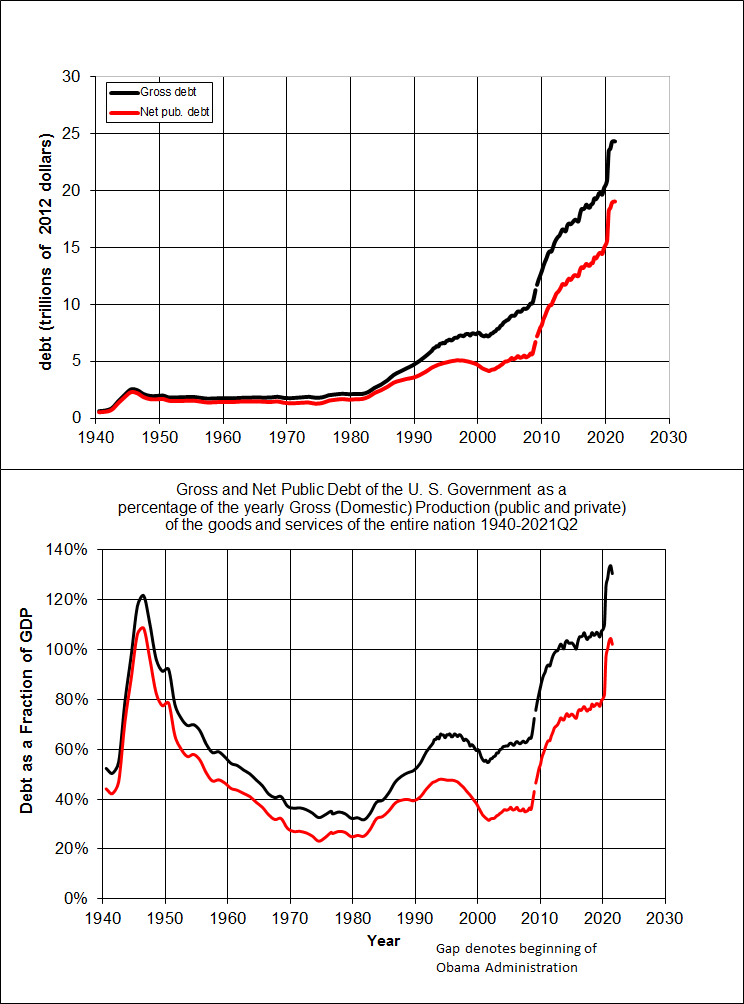
Not only did we have wars, we somehow managed to pay the debt down at the same time. Take a look at historical debt for the US government. It was amazing until the 80's.


So we've resolved this debt ceiling business now. As I show here the effective tax rate for high income earners prior to 1980 was about 70%. Reagan brought that right down to about 37%. Right about where the debt starts to take off. Clinton raised them again to just shy of 50%. That is, right about where the debt starts to come back down. Then Bush brought them back to where they were a bit lower than the Reagan levels. That is, right about where the debt skyrockets again.

The solution for the debt ceiling? Not a return to Clinton era tax levels. Keep the Bush tax levels. Why? I don't know. But that's what most economists think we should do.

Monday, August 1, 2011

We Should Listen to Krugman

We don't have time to do research projects on every topic, so probably most people live with imperfect short cuts when we want to figure out the answers to complicated or controversial questions.

One option is to try and figure out the consensus opinion and go with that. That's a good first order approximation. Another is to try and look at track records. That plays a big role for me.

The right really turned me off for the first time with the Iraq WMD failures. Not that the left didn't think Saddam had WMD. But the right was loudly touting conclusions based on bad evidence. The experts on the right in my view had a preferred conclusion and it overrode their ability to evaluate the evidence correctly.

The right did the same when it came to the motives of Islamic terrorists. It's obvious to me that Islamic terrorists are motivated by US violence. But on the right the view that they hate us because we're so great, which is obviously a preferred view since it strokes the ego, has a major foothold. The right has a powerful ability to allow their preferred conclusions to blind them to what in my view are obvious errors.

When Reagan raised taxes the right predicted dire economic consequences. The same happened when Clinton raised taxes. Those predictions were quite wrong. The right predicted that the Bush tax cuts would lead to prosperity and growth. What we actually have is just about the worst economic performance since the Great Depression in the wake of Bush's economic policies.

These things matter a great deal to me. It impresses me when a study shows that Paul Krugman is the top prognosticator, and Cal Thomas the worst. These things are not easy and you wouldn't expect even the smartest person to be right all the time. You can't anticipate some things that can effect predictions.

But probably his evaluation of this debt ceiling limit deal is worth considering. The Republicans pretty much got everything they wanted. No tax increases, massive cuts in entitlement spending. This in the middle of a terrible economic down turn with 9% unemployment. Here's Krugman on This Week(watch Part 2 here). He's expecting continued extremely high unemployment through the end of next year. He doesn't add this, but I suppose that's not going to bode well for Obama's re-election.

And I tend to think that's a good thing. The guy right flanks even Republican voters. That's been true for war, health care, and now taxes/entitlement spending. And lest you think this is about Obama being just unable to overcome Republican pressure, read Greenwald. Same old thing. If there's no price to be paid for a Democratic President when he acts like an extremist Republican, then why shouldn't everybody act like an extremist Republican.